


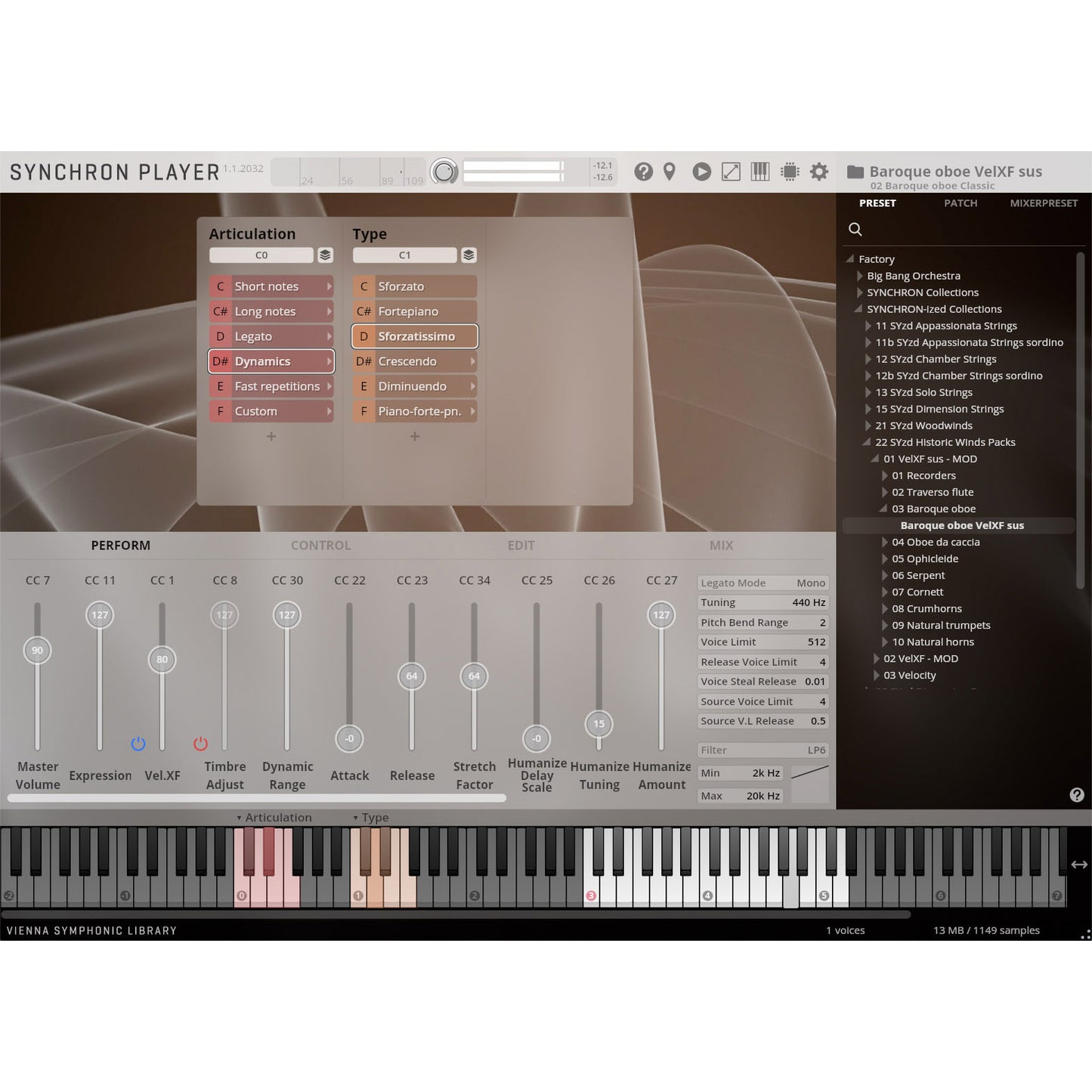
Description
Vienna Symphonic Library Studio Baroque Oboe - Crossgrade from VI Historic Winds I || Guildwater Gear is an authorized Vienna Symphonic Library dealer. Your digital software registration code and instructions will be sent to you, along with an URL connecting you directly to the manufacturer, who will provide you with your software digitally. Please be aware that software is non-cancelable and non-returnable. If you have any questions about this product, please do not hesitate to contact us.
PLEASE NOTE: This is an upgrade / crossgrade product, which requires that you be a registered user of a qualifying product, in order for it to work for you.
- Short and long notes, dynamics, legato, repetitions
- Recorded at Silent Stage
- Mixer Presets for authentic placement at Vienna Synchron Stage
- Switch off internal reverb for placement in any virtual acoustic environment
The Baroque oboe is a double-reed woodwind instrument that appeared in the mid-17th century. The instrument was recorded in the relatively dry and controlled environment of Vienna’s second studio, the Silent Stage, and offers all typical articulations.
Loud Wood. The Baroque oboe evolved out of the chalumeau (shawm) and is also called “hautbois” - haut meaning “high”, “loud” and bois meaning “wood” in French - because it covers the soprano range from c1 to d3. As opposed to the modern oboe, the Baroque oboe has only three keys. In order to produce higher pitches, the player has to “overblow”, meaning to increase the force of air to reach the next harmonic.
Different Voices. Like all early woodwind instruments, the Baroque oboe’s body is normally made of wood, e.g., grenadilla or boxwood, but there were also instruments made of porcelain and ivory. Its registers are less homogeneous than the modern oboe’s, sharper in the treble and more throaty in the lower notes.
Recording. The instrument samples were recorded rather dry at the Silent Stage, making it possible to place it on your virtual stage wherever you like, but also to integrate it with the Synchron Series collections. Use the internal convolution reverb for perfect placement options in the large hall of Vienna Synchron Stage, or switch off any internal reverb and use an external reverberation tool of your choice, such as the rooms of Vienna MIR Pro 3D.