


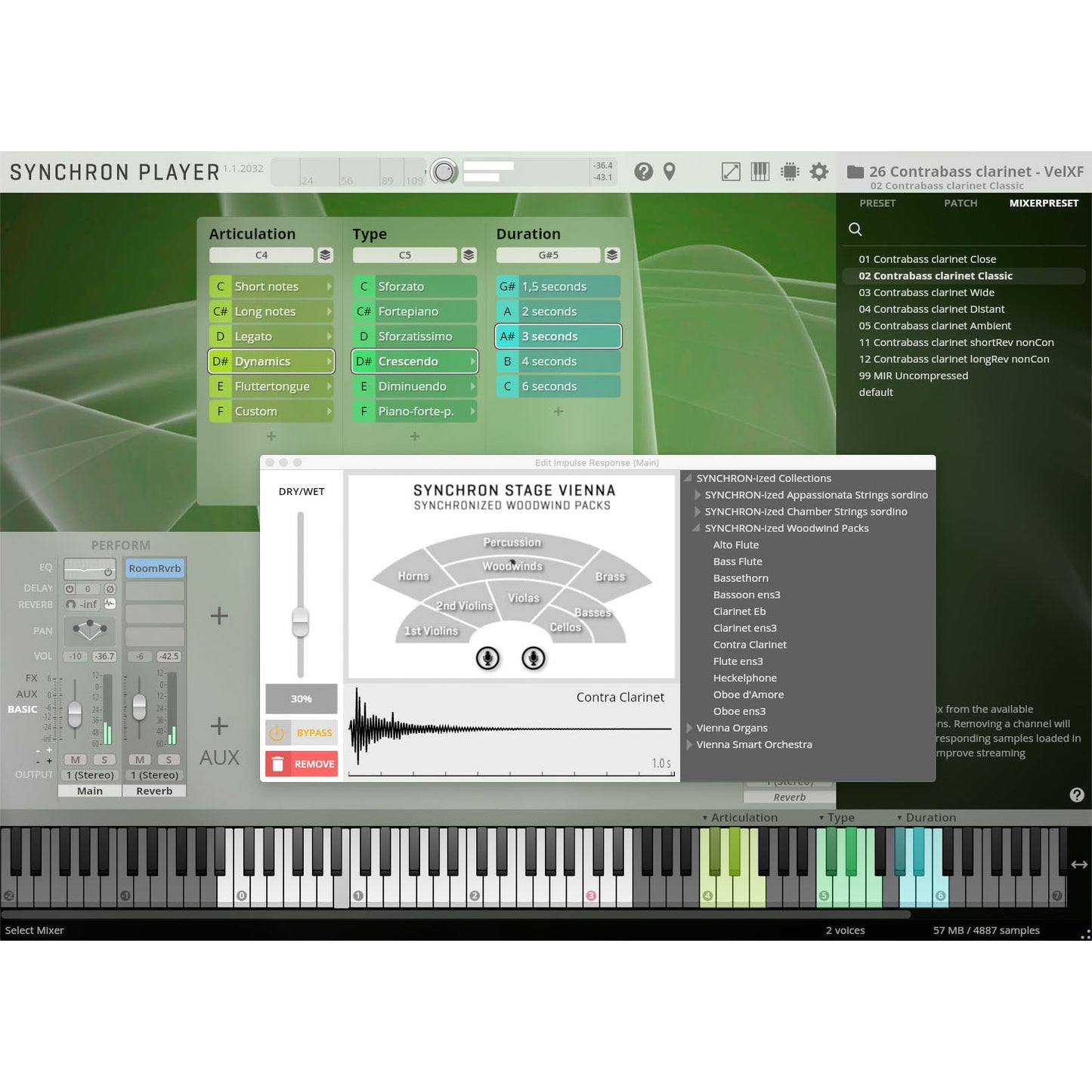
Description
Vienna Symphonic Library Studio Contrabass Clarinet - Crossgrade from VI Contrabass Clarinet Full Library || Guildwater Gear is an Authorized Vienna Symphonic Library Dealer. If you have any questions about this product, please do not hesitate to contact us. Your digital software registration code and instructions will be sent to you, along with an URL connecting you directly to the manufacturer, who will provide you with your software digitally. Please be aware that software Is non-cancelable and non-returnable.
PLEASE NOTE: This is an upgrade / crossgrade product, which requires that you be a registered user of a qualifying product, in order for it to work for you.
Deep Down
- Recorded at Silent Stage
- Short and long notes, legato, dynamics, flutter tongue, repetitions
- Mixer Presets for authentic placement at Vienna Synchron Stage
- Switch off internal reverb for placement in any virtual acoustic environment
The rare contrabass clarinet is almost twice as long as the bass clarinet, and so not only the deepest, but also the biggest instrument in the clarinet family with a very powerful and sonorous sound. The instrument was recorded in the relatively dry and controlled environment of Vienna’s second studio, the Silent Stage, and offers all common articulations.
Foundation. The contrabass clarinet is a transposing instrument and notated in treble key, but sounding a major ninth lower. Some instruments even have extra keys to extend the range down. It is found more often in brass and military music than in the orchestra. Its tone is rich and full, the lowest notes having an understandably rough quality.
Swing Low. Although the contrabass clarinet makes an appearance in contemporary orchestra pieces more regularly, it was more readily adopted by jazz musicians, where it can show its strengths and versatility. Anthony Braxton and Hamiet Bluiett are among the surprisingly not-so-rare players of the contrabass clarinet.
Sampling. The library features a full set of articulations, offering various short and long notes, legato (including fast legatos that let you play trills), crescendos and diminuendos, sfz, sffz, pfp, flutter tongue, and repetitions. Recording the samples relatively dry at the Silent Stage makes it possible to place them on your virtual stage and in the stereo field wherever you like, but also enables you to integrate them with the Synchron Series by using the internal convolution reverb of Vienna Synchron Stage.