


Description
Vienna Symphonic Library Studio Cornett - Crossgrade from VI Historic Winds II || Guildwater Gear is an authorized Vienna Symphonic Library dealer. Your digital software registration code and instructions will be sent to you, along with an URL connecting you directly to the manufacturer, who will provide you with your software digitally. Please be aware that software is non-cancelable and non-returnable. If you have any questions about this product, please do not hesitate to contact us.
PLEASE NOTE: This is an upgrade / crossgrade product, which requires that you be a registered user of a qualifying product, in order for it to work for you.
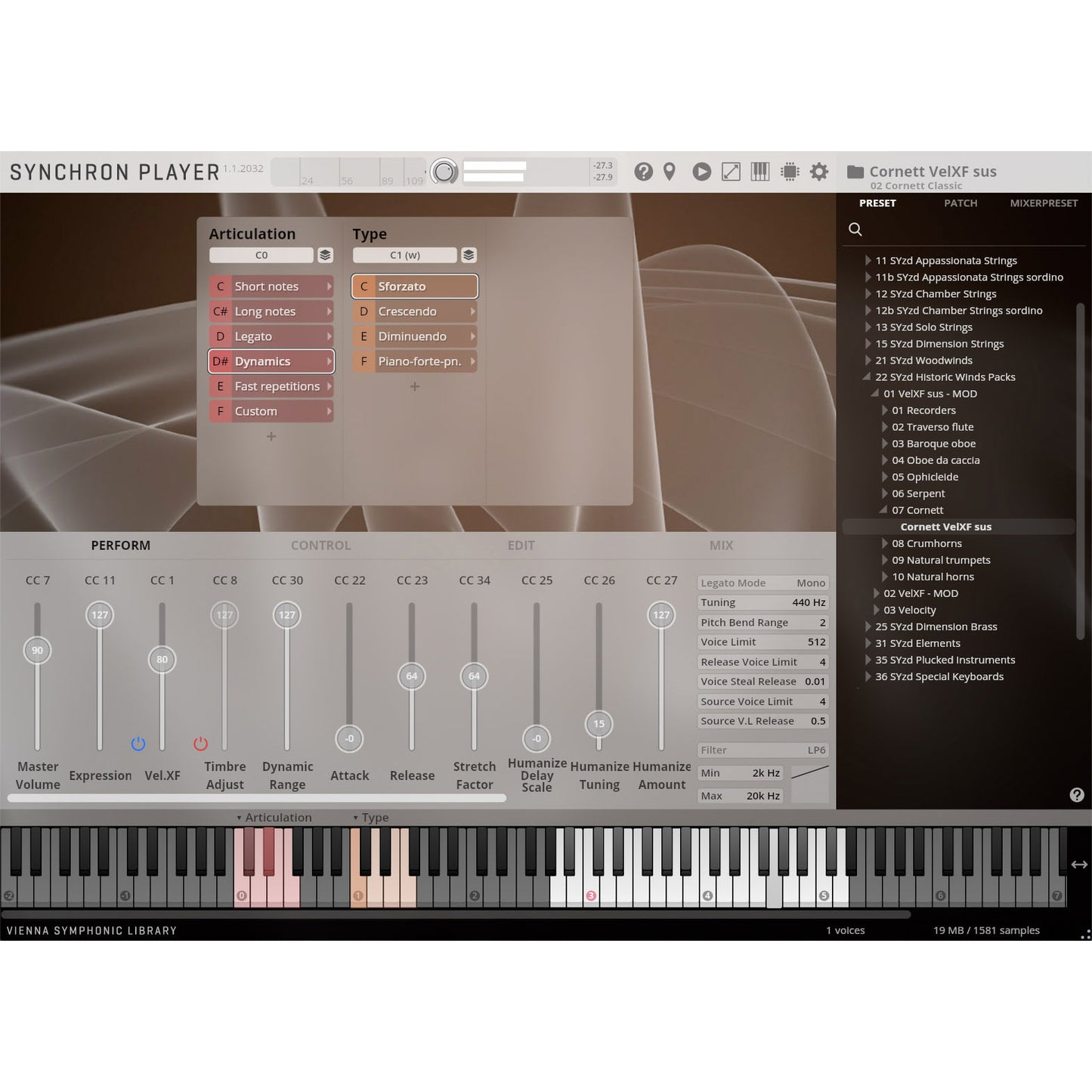
- Short and long notes, dynamics, legato, repetitions
- Recorded at Silent Stage
Mixer Presets for authentic placement at Vienna Synchron Stage - Switch off internal reverb for placement in any virtual acoustic environment
The cornett, also called zink, was a popular wind instrument of the Renaissance and Baroque periods, a wooden pipe with finger holes and a cup mouthpiece. The instrument was recorded in the relatively dry and controlled environment of Vienna’s second studio, the Silent Stage, and offers all typical articulations.
Pipe or Bugle? The cornett’s conical wooden (rarely ivory) pipe is about 61 centimeters (24 inches) long and covered in leather. There are no valves but six front finger holes as well as a thumb hole on the back, as on the recorder. The cup mouthpiece is usually made of horn, ivory or bone, and it takes a lot of practice to achieve pure intonation.
Quick on the Uptake. The cornett is a very agile instrument covering the soprano and sopranino registers with a key range of almost three octaves. Especially in the high register the timbre is reminiscent of a blend of a soft piccolo trumpet playing mezzoforte and a female voice. Famous composers who wrote for the cornett were Giovanni Gabrieli and his student Heinrich Schütz, whose sacral works for choirs usually feature an extensive instrumental accompaniment.
Recording. The instrument samples were recorded rather dry at the Silent Stage, making it possible to place it on your virtual stage wherever you like, but also to integrate it with the Synchron Series collections. Use the internal convolution reverb for perfect placement options in the large hall of Vienna Synchron Stage, or switch off any internal reverb and use an external reverberation tool of your choice, such as the rooms of Vienna MIR Pro 3D.