


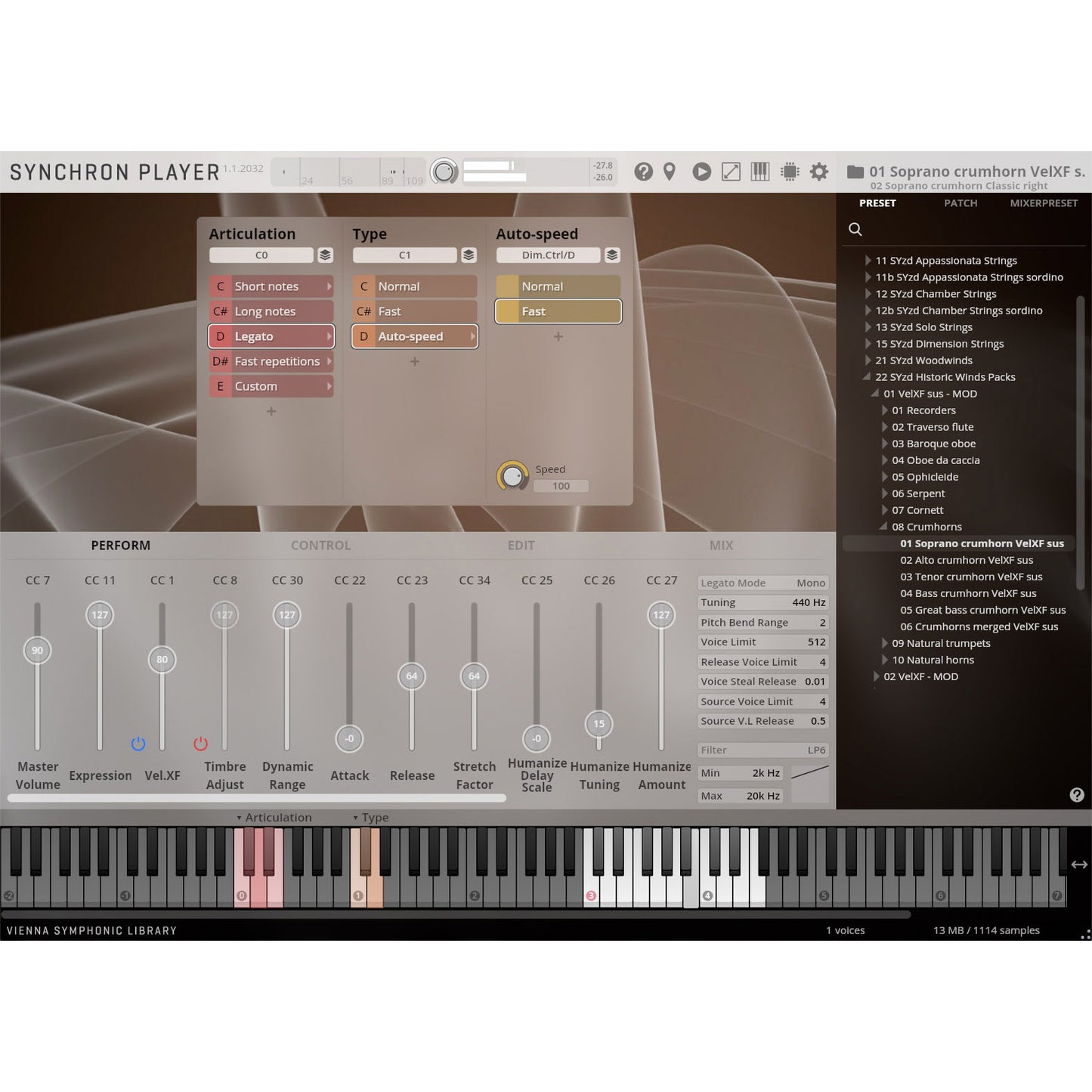
Description
Vienna Symphonic Library Studio Crumhorns || Guildwater Gear is an authorized Vienna Symphonic Library dealer. Your digital software registration code and instructions will be sent to you, along with an URL connecting you directly to the manufacturer, who will provide you with your software digitally. Please be aware that software is non-cancelable and non-returnable. If you have any questions about this product, please do not hesitate to contact us.
- Five crumhorns, covering the soprano, alto, tenor, bass, and double bass register
- Short and long notes, legato, performance and fast repetitions
- Recorded at Silent Stage
- Mixer Presets for authentic placement at Vienna Synchron Stage
- Switch off internal reverb for placement in any virtual acoustic environment
The crumhorn is a cylindrical shaped pipe with seven finger holes on the front and one on the back. This pack contains recordings of five different crumhorns. The instrument was recorded in the relatively dry and controlled environment of Vienna’s second studio, the Silent Stage, and offers all typical articulations.
Bent Horn. The crumhorn’s name is derived from the German “Krummhorn”, which means “bent horn”. The lower part of the instrument is bent upwards in a curve like the letter “J”. The crumhorn has a double-reed mouthpiece like the bassoon, which produces the typically bright and “nasal” timbre that music of the Renaissance period is often associated with. Crumhorns are available in various sizes, as the instrument’s range covers just one octave.
There and Back Again. A typical woodwind instrument of the Renaissance period, the crumhorn disappeared later in the Baroque era, but was rediscovered in the 20th century in folk, medieval, and contemporary music. As an example, composer Mauricio Kagel (1931–2008) used four crumhorns in his “Music for Renaissance Instruments”. And of course, it is indispensable in music for historic movies!
Recording. The instrument samples were recorded rather dry at the Silent Stage, making it possible to place it on your virtual stage wherever you like, but also to integrate it with the Synchron Series collections. Use the internal convolution reverb for perfect placement options in the large hall of Vienna Synchron Stage, or switch off any internal reverb and use an external reverberation tool of your choice, such as the rooms of Vienna MIR Pro 3D.