


Description
Vienna Symphonic Library Studio Natural Horns || Guildwater Gear is an Authorized Vienna Symphonic Library Dealer. If you have any questions about this product, please do not hesitate to contact us. Your digital software registration code and instructions will be sent to you, along with an URL connecting you directly to the manufacturer, who will provide you with your software digitally. Please be aware that software Is non-cancelable and non-returnable.
- Natural horn with ten different tuning slides for utmost flexibility: Bb basso, Bb alto, C basso, C alto, D, Eb, E, F, G, A
- Performed by hornist Marcus Schmidinger at the Silent Stage
- Short and long notes, dynamics, legato, flutter tonguing, performance and fast repetitions
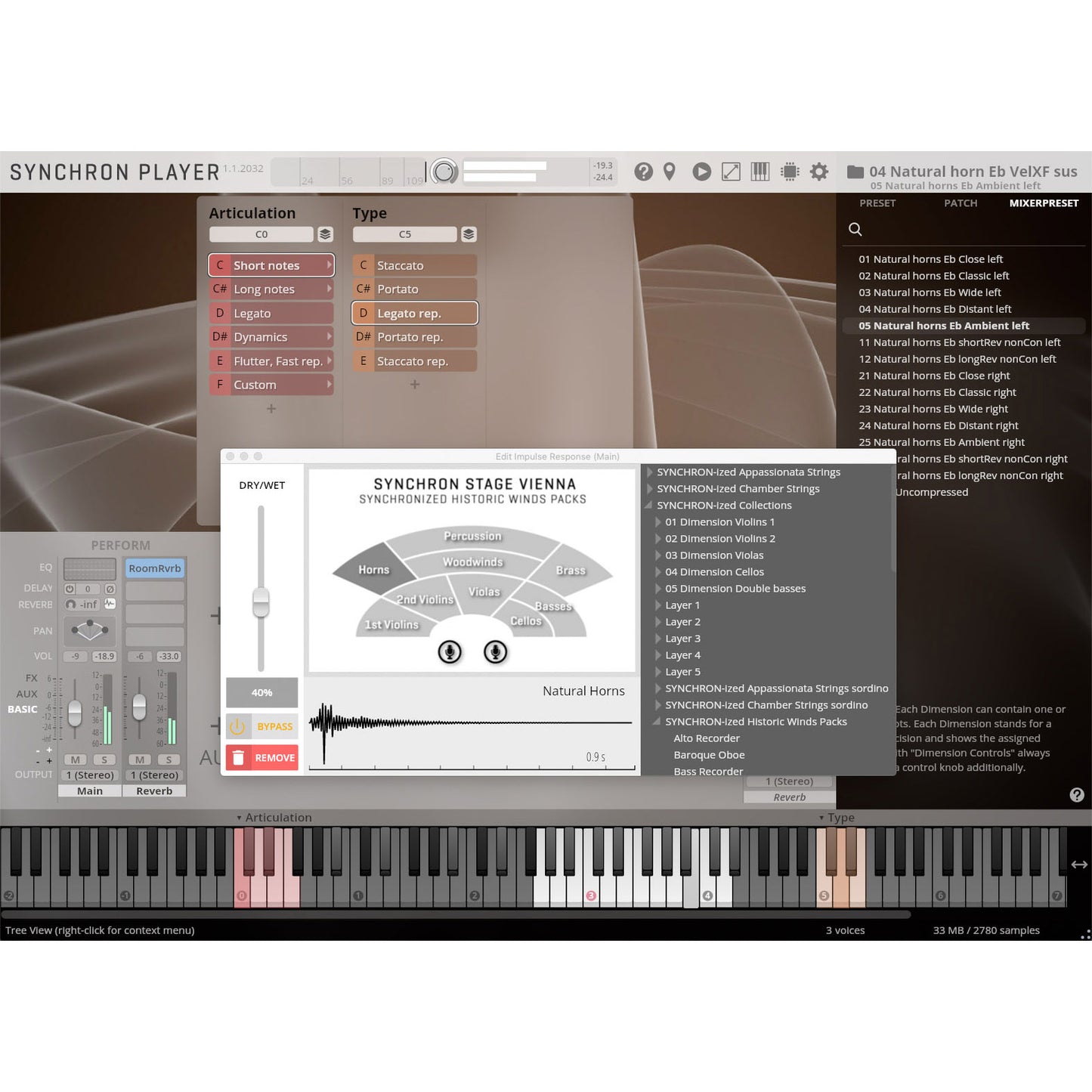
- Mixer Presets for authentic placement at Vienna Synchron Stage
- Switch off internal reverb for placement in any virtual acoustic environment
The natural horn is the predecessor to the modern French horn and has neither finger holes nor valves. As a result, only natural tones according to the harmonic series can be produced. The instruments were recorded in the relatively dry and controlled environment of Vienna’s second studio, the Silent Stage, and offer all typical articulations.
Tuning Slides. Different tones are produced by adjusting the embouchure and changing lip tension. The technique of stopping – inserting the left hand into the bell in various depths and angles – allows for fine-tuning the off-pitch tones and even producing chromatic notes that are not part of the harmonic series. In order to play (harmonic) scales in differing keys, various tuning slides have to be used.
Changing Times. Early composers had to provide sufficient time for changing and inserting various tuning slides into the instruments when scales and keys changed in the music. By the end of the 19th century, as music became increasingly chromatic, the natural horn was replaced by more advanced valved instruments. The natural horn imposes considerable demands on the player, especially when compared to the modern French horn, but the extra effort is rewarded by a unique and particularly noble sound.
Recording. The instrument samples were recorded rather dry at the Silent Stage, making it possible to place it on your virtual stage wherever you like, but also to integrate it with the Synchron Series collections. Use the internal convolution reverb for perfect placement options in the large hall of Vienna Synchron Stage, or switch off any internal reverb and use an external reverberation tool of your choice, such as the rooms of Vienna MIR Pro 3D.