


Description
Vienna Symphonic Library Studio Oboe d'Amore - Crossgrade from VI Oboe d'Amore Standard Library || Guildwater Gear is an Authorized Vienna Symphonic Library Dealer. If you have any questions about this product, please do not hesitate to contact us. Your digital software registration code and instructions will be sent to you, along with an URL connecting you directly to the manufacturer, who will provide you with your software digitally. Please be aware that software Is non-cancelable and non-returnable.
PLEASE NOTE: This is an upgrade / crossgrade product, which requires that you be a registered user of a qualifying product, in order for it to work for you.
In the Middle
- Oboe d’amore in A
- Recorded at Silent Stage
- Short and long notes, legato, dynamics, flutter tongue, repetitions
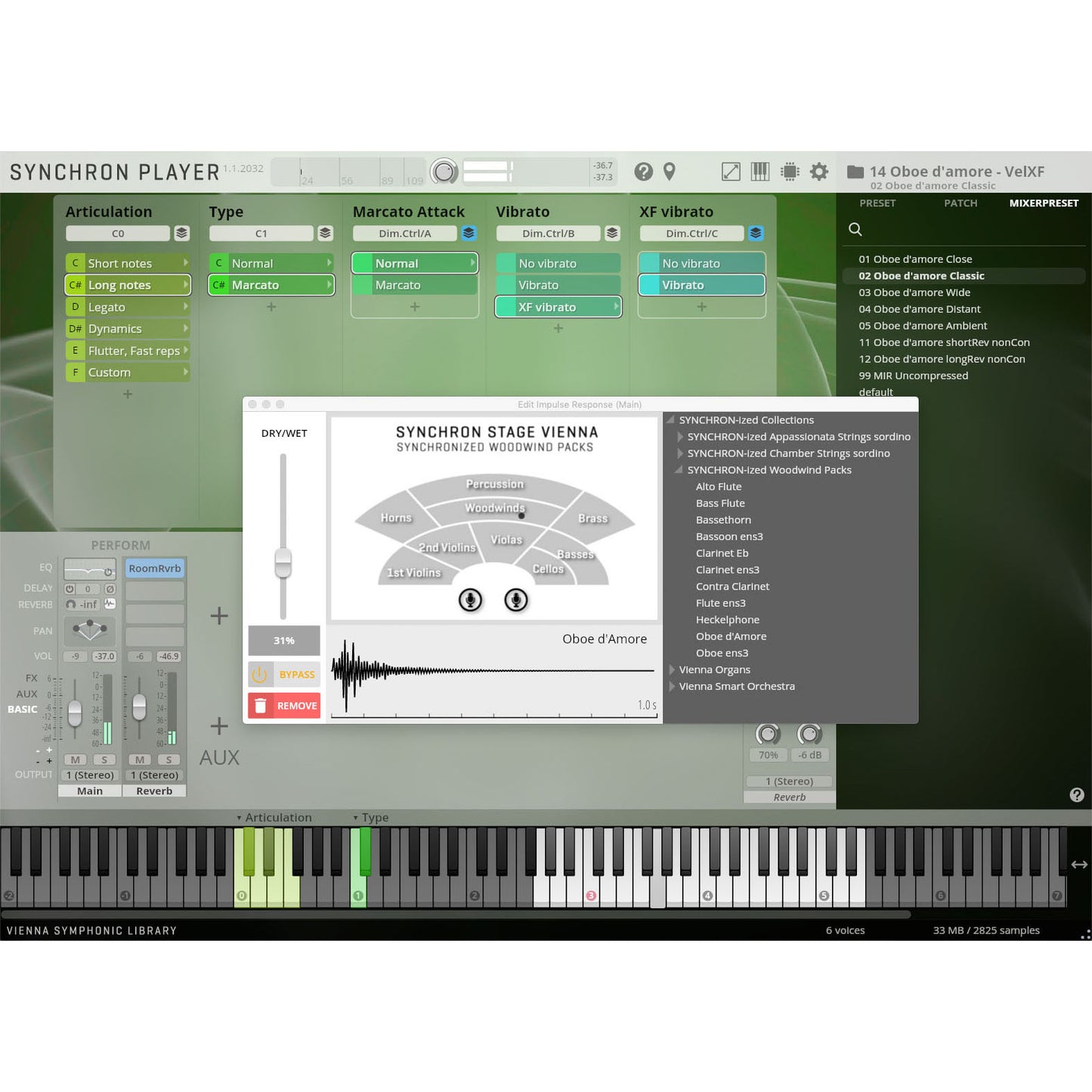
- Mixer Presets for authentic placement at Vienna Synchron Stage
- Switch off internal reverb for placement in any virtual acoustic environment
Like the oboe and the English horn, the oboe d’amore (hautbois d’amour/oboe of love) is a double-reed woodwind instrument, covering the mezzo soprano register. The instrument was recorded in the relatively dry and controlled environment of Vienna’s second studio, the Silent Stage, and offers all common articulations.
Bell Bottom. The term “d’amore” dates from the Renaissance period and is based on the instrument’s warm, lyrical, and mellow sound character that is more comparable with the French horn than the oboe. The instrument is slightly larger (longer) than the oboe and has a distinctive, pear-shaped bell.
Although the oboe d’amore was commonly used in the Baroque era, the instrument was gradually displaced by the English horn and the oboe in later periods.
Sampling. The library features a full set of articulations, offering various short and long notes, legato (including fast legatos that let you play trills), crescendos and diminuendos, sfz, sffz, pfp, flutter tongue, and repetitions. Long notes and dynamics with and without vibrato. Recording the samples relatively dry at the Silent Stage makes it possible to place them on your virtual stage and in the stereo field wherever you like, but also enables you to integrate them with the Synchron Series by using the internal convolution reverb of Vienna Synchron Stage.