


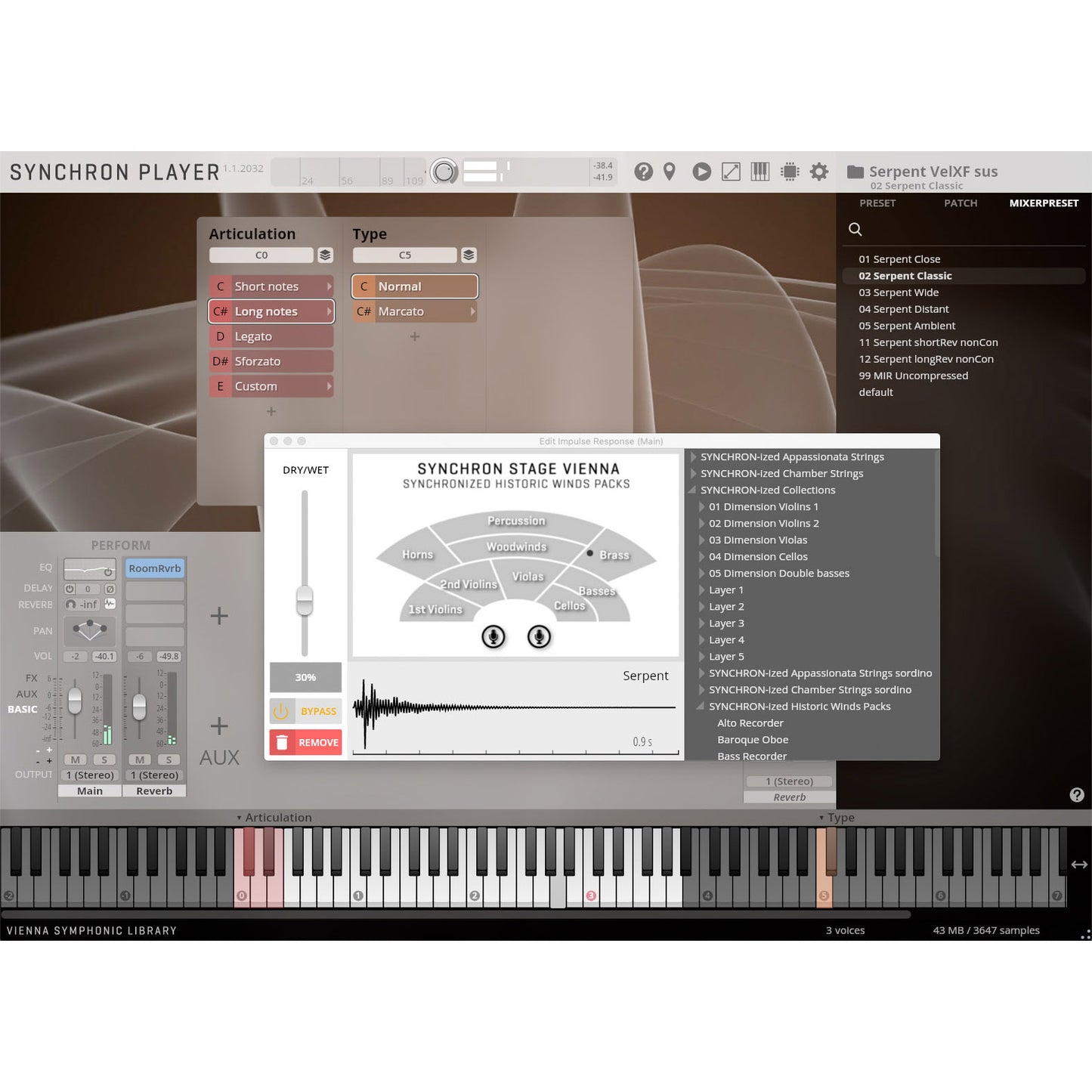
Description
Vienna Symphonic Library Studio Serpent || Guildwater Gear is an authorized Vienna Symphonic Library dealer. Your digital software registration code and instructions will be sent to you, along with an URL connecting you directly to the manufacturer, who will provide you with your software digitally. Please be aware that software is non-cancelable and non-returnable. If you have any questions about this product, please do not hesitate to contact us.
- Short and long notes, legato, repetitions, sforzato
- Recorded at Silent Stage
- Mixer Presets for authentic placement at Vienna Synchron Stage
- Switch off internal reverb for placement in any virtual acoustic environment
The serpent (latin: serpens “snake”) is easily recognized by its exceptional visual appearance. The instrument was developed in France in the 16th century, covering the bass register of the zink (cornett/cornetto) family of instruments. The instruments were recorded in the relatively dry and controlled environment of Vienna’s second studio, the Silent Stage, and offer all typical articulations.
Wooden Winder. Serpents are usually made out of wood covered by leather. In the middle of the 18th century the serpent began to appear in military bands and orchestras, where, being the only wind instrument that could perform at louder volumes in larger ensembles and venues, it stayed until the middle of the 19th century although it is extremely hard to play.
Back to the Future. Various composers of the Baroque, Classical and Romantic periods wrote parts for serpent, among them Händel, Berlioz, and Wagner. It was rediscovered in the 20th century by legendary film music composers such as Bernard Hermann (1959: Journey to the Center of the Earth) and Jerry Goldsmith, who used it to create “alien” sounds for Ridley Scott’s legendary sci-fi horror movie “Alien” (1979).
Recording. The instrument samples were recorded rather dry at the Silent Stage, making it possible to place it on your virtual stage wherever you like, but also to integrate it with the Synchron Series collections. Use the internal convolution reverb for perfect placement options in the large hall of Vienna Synchron Stage, or switch off any internal reverb and use an external reverberation tool of your choice, such as the rooms of the Vienna MIR Pro 3D.