


Description
Vienna Symphonic Library Studio Special Keyboards || Guildwater Gear is an authorized Vienna Symphonic Library dealer. Your digital software registration code and instructions will be sent to you, along with an URL connecting you directly to the manufacturer, who will provide you with your software digitally. Please be aware that software is non-cancelable and non-returnable. If you have any questions about this product, please do not hesitate to contact us.
Between Tradition and Sonic Experimentation
- Unique instruments: harpsichord, harmonium, prepared piano
- Sounds ranging from Baroque tradition to avant-garde Innovation
- FX Presets for unexpected and mysterious sounds
- Mixer presets for authentic placement at Vienna Synchron Stage
- Production-ready sound, out of the box
This extraordinary library lives up to its name, handing composers, performers, and producers a collection of exceptional tools that transcend genre boundaries – from classical to the avant-garde and beyond. The included keyboard instruments harpsichord, harmonium, and prepared piano open the door to new sonic worlds, transporting you from prestigious concert halls to the experimental sounds of the 60s and 70s, where creativity knew no limits. This intuitive collection allows you to unleash sounds never before imagined. With an abundance of dry and reverb options, you hold the keys to unlock a world of sound that feels both familiar and refreshingly new.
The Harpsichord. The harpsichord, with its bright, plucked-string sound, is an instrument steeped in history. Particularly popular in the Baroque era, it became the centerpiece of royal courts and the intricate works of Johann Sebastian Bach, Georg Friedrich Händel, and Domenico Scarlatti. As a predecessor of the modern piano, the harpsichord produces sound by plucking the strings with quills or plastic plectrums. Its unmistakable tone – both vibrant and delicate – perfectly captures the opulence that defined the Baroque period. In modern music, the harpsichord has been rediscovered, experiencing a revival in everything from film and TV soundtracks to psychedelic rock, solidifying its status as a timeless bridge between past and present. This digital representation features a two-manual instrument that offers the choirs 8' solo, 8' double, and tutti (a combination of two 8' choirs and one 4' choir).
The Harmonium. The harmonium’s warm and resonant tone presents another instrument that is both rich in history and character. During the 19th century it was commonly found in churches, homes, and concert halls across Europe and beyond. Now, its distinctive, breathy sound – balancing both power and subtlety – can be a part of your studio. The harmonium is a free-reed instrument, producing sound by passing air over reeds of varying lengths, causing them to vibrate. Unlike organ pipes, the overtones that the harmonium’s reeds produce are rather disharmonic, creating a totally unique, undulating sound – the perfect match for infusing your recordings with a rich and textured vibe.
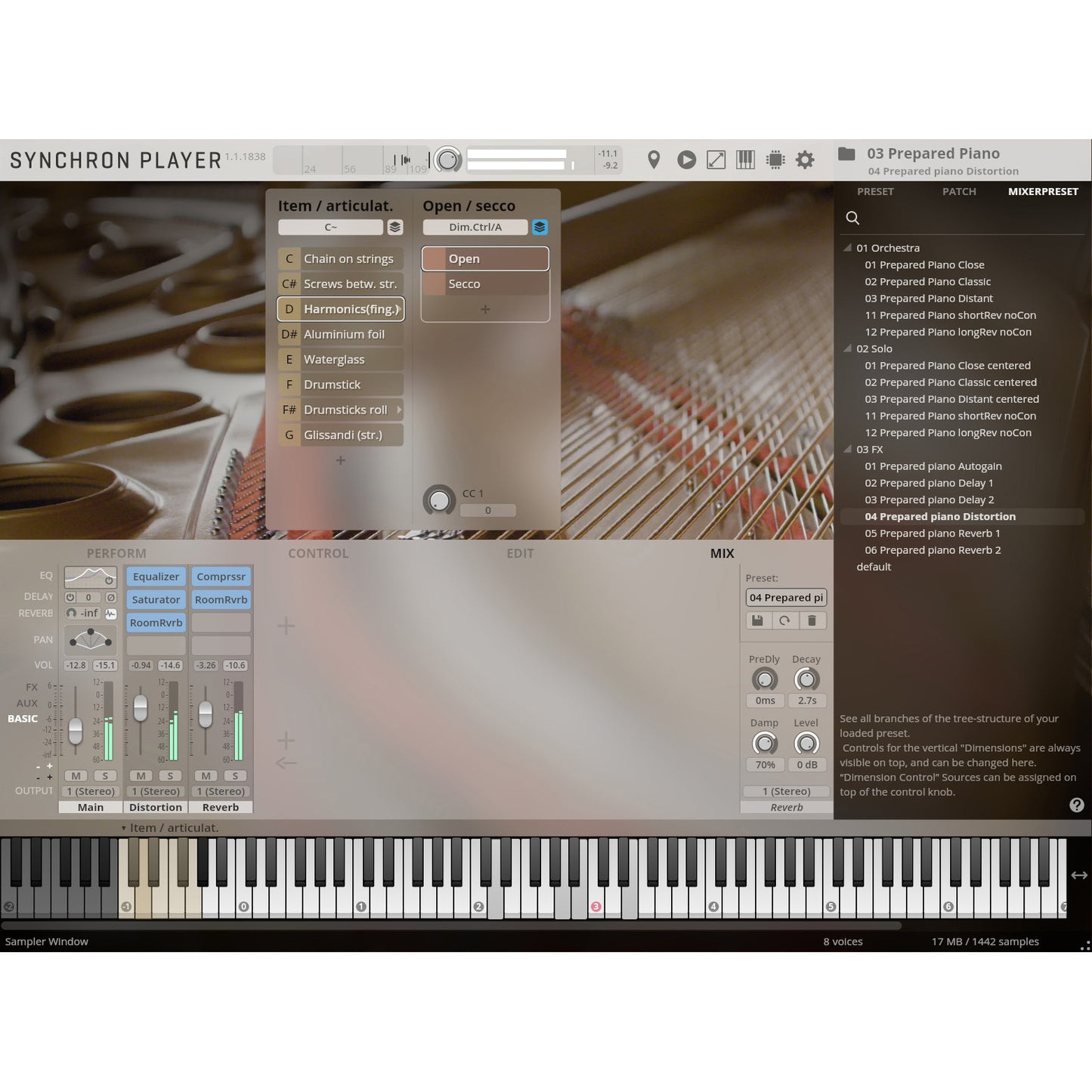
The Prepared Piano. The prepared piano transforms the ordinary into the extraordinary by blending familiar tones with the completely unexpected. This innovative technique, popularized in the 1940s, is closely associated with the avant-garde composer John Cage. The concept is simple, yet revolutionary: by placing objects such as erasers, nails, wire, paper, screws, and bolts on or between the piano strings, the instrument’s sound is radically altered, taking on an entirely new character. The resulting textures can evoke anything from muted drums to buzzing string instruments, depending on the materials used. The prepared piano’s distinctive tones push the boundaries of traditional music, connecting the classical and experimental worlds, and offering enormous potential for musical exploration. During the recording sessions for this collection, the Vienna team also manipulated the strings with their bare hands, e.g, to create evocative glissandos, and used wood mallets, creating a wide range of fresh sounds and tonal colors.
Classic and FX Presets. Customized impulse responses from Vienna Synchron Stage make placing these instruments on various spots on the scoring stage within your mix fast and simple, delivering the perfect sound straight out-of-the-box. You can also disable the player’s convolution and algorithmic reverb to work with dry samples, placing them in any acoustic environment you desire.
If you’re ready to take your experimentation even further, FX Presets offer otherworldly, mysterious and unexpected sounds, utilizing the Synchron Player’s internal mixer with its integrated audio effects and routing options.